AI’s $3-trillion spill and what it means for Indian ads
Big Tech's AI bills erased $3 trillion and hit Nasdaq 5.5%, yet India's festive ad spending is projected at ₹60,000–62,000 crore. What CMOs should watch.
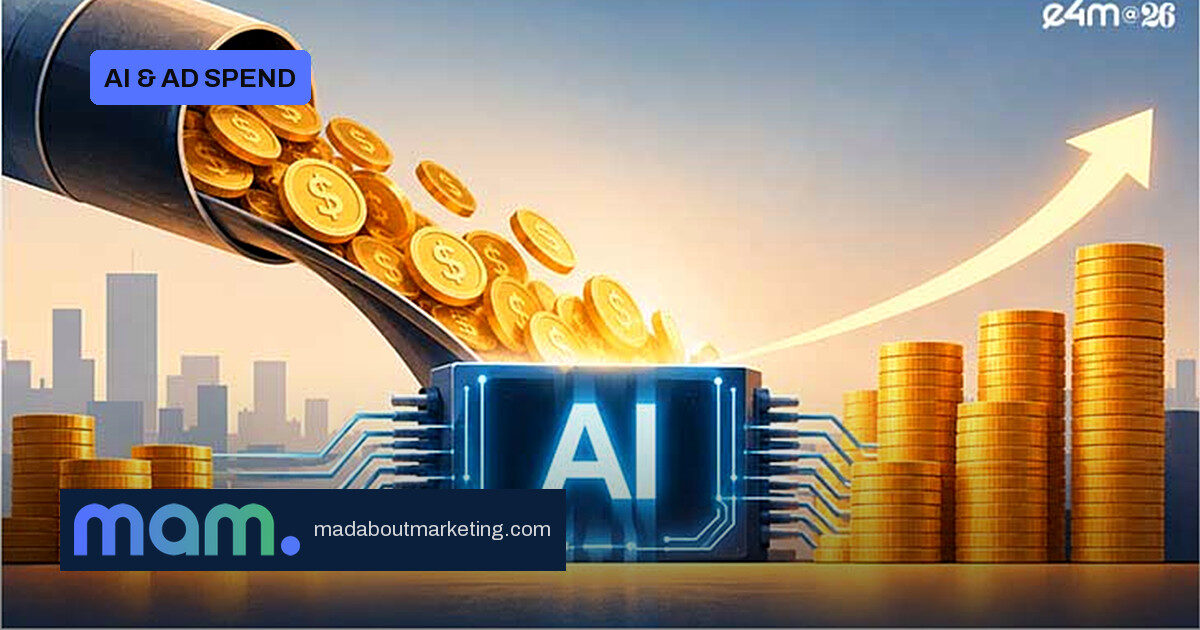
The AI race has finally presented its electricity bill, and Wall Street just read it out loud. On 5 November, the Nasdaq Composite fell 5.5% — its worst single-day drop in 19 months — and about $3 trillion was wiped from S&P 500 companies as investors questioned what Big Tech’s AI ambitions actually cost.
For Indian CMOs, the sell-off looks like someone else’s problem. But it is not, because the same platforms that dominate Indian digital advertising are now under pressure to show that AI can pay for itself.
01 · What spooked the market
The trigger was a fresh set of Big Tech earnings. Alphabet reported quarterly revenue of $127.58 billion, including $82.01 billion from advertising, a healthy business by any conventional measure. The problem was capital expenditure: $51.36 billion in one quarter, producing negative free cash flow of $9.07 billion. Alphabet’s stock fell 12.6% after the results.
Meta, Microsoft and Amazon told a similar story — strong core revenues, enormous infrastructure commitments and shareholders less willing to wait for future profits.
02 · Why India did not panic
Indian equities moved in the other direction. On 6 November, the Sensex rose 2.17% and the Nifty gained 2.01%, helped by foreign inflows and lower exposure to capital-intensive AI infrastructure. India’s consumer-first economy offered a cushion that AI hardware exporters in Taiwan and South Korea did not have.
But market insulation is not commercial isolation. India’s ad economy remains wired into the very companies facing the correction.
03 · The Indian spending picture
Datum Intelligence puts festive advertising expenditure at ₹60,000–62,000 crore in 2026, with digital commanding nearly 68% of that spending. Commerce and retail media alone are expected to attract ₹11,500 crore, growing 27% year on year.
Big Tech is not just collecting Indian ad money; it is spending it too. Google was the largest advertiser across linear television and connected TV during IPL 2026, accounting for 11% and 13% of advertising volumes respectively, according to TAM Sports.
04 · What CMOs should do
None of this establishes that Indian ad budgets are about to contract. Google and Meta continue to generate large advertising revenues; their issue is the cost of building businesses beyond their existing models. The more likely change is a sharper focus on returns.
- Re-audit AI martech: keep tools that demonstrably cut production costs, improve targeting or generate sales.
- Treat market turmoil as a platform-pricing signal, not a demand signal: local consumer demand and campaign performance matter more to budgets than a US sell-off.
- Watch data-centre policy: energy and water restrictions could shape AI availability and cost for the platforms you buy.
The conversation around AI has shifted. For years the industry asked what AI could do. Now investors want to know what it costs, governments want to know where the power comes from, and marketers must ask what measurable result they are actually buying.
Source: Indian Advertising Media & Marketing News – exchange4media