Spinny’s Manki Bhai series tops 16 million views
Spinny's six-part Instagram series with creator Akash Srivastava uses AI characters to turn the new vs pre-owned car debate into family conversation.
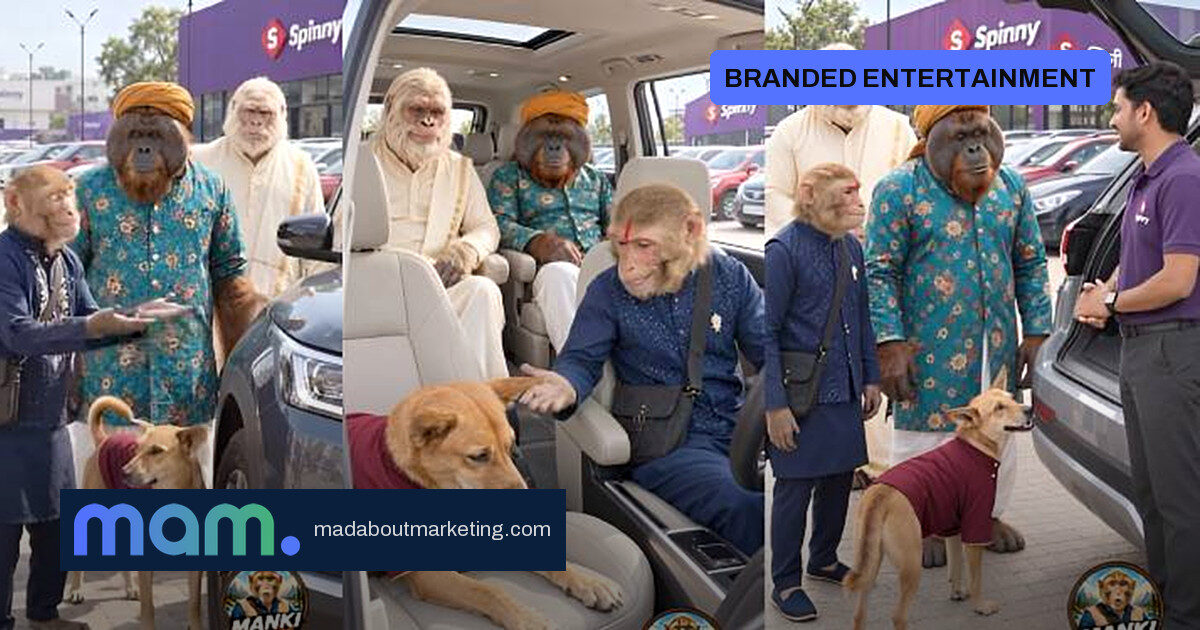
Spinny has taken a detour from standard car advertising. The Gurugram-based used-car platform built a six-part Instagram series around Manki Bhai, Monkesh and their world—AI-animated characters from creator Akash Srivastava’s Manki Vlogger channel.
Released between October 16 and 23, 2026, the campaign had crossed over 16 million views and 6.7 lakh engagements by October 27. Five of the six episodes individually passed one million views.
01 · The story does the selling
The narrative follows the group from Banaras to Lucknow after cancelled cab bookings and too much luggage force a car hunt. Manki Bhai wants a spacious SUV, Tau watches the EMI, Dada has advice, and Dogesh has his own agenda. The search ends at a Spinny Park in Lucknow, where they choose a pre-owned Toyota Innova Crysta and celebrate its arrival with a coconut-breaking ceremony.
It is an entertainment-first structure. Spinny appears as a destination inside a story, not as a message interrupting one.
02 · Why this matters for brand teams
For CMOs and brand managers, the campaign shows what changes when creators own the format. Srivastava’s characters already carry recognition and tone; the brand borrows that instead of building a new world from scratch. The new-versus-pre-owned debate unfolds through familiar family friction—EMIs, opinions, priorities—rather than through a feature list.
- Established creator IP lowers the cost of attention: the audience is already invested in the characters.
- Episodic release builds repeat viewing and gives the brand six touchpoints instead of one.
- Humour and tension carry the message; the product decision lands as the story’s outcome.
Akash Srivastava said he had thought about buying a car from Spinny himself, “so it’s lovely to see my characters get there before me.” The line captures the collaboration’s tone: personal, character-first, and almost invisibly branded.
The campaign also points to a newer creative tool. AI-animated characters let a creator produce episodic stories at speed while keeping the same faces and relationships. For a brand, that means continuity and recognisability without a celebrity calendar or a full production shoot.
For Indian auto marketers, the lesson is blunt. Used cars carry trust and resale questions; a conventional feature-heavy ad often raises those objections. A six-part family story can answer them sideways, through Tau’s EMI worry or the group’s final choice.
03 · The takeaway
Spinny’s numbers are strong, but the strategic point is how they were earned. The campaign did not interrupt content; it became content. For categories where purchase decisions are long and emotional—like cars—letting a trusted creator dramatise the dilemma can outperform a product-led ad.
Source: MediaNews4U