Mia by Tanishq’s 230-design festive push courts self-gifting
Mia by Tanishq's Lightscapes collection brings 230-plus designs and self-purchase positioning to India's festive jewellery season.
Festive jewellery in India has long meant heavy gold, weddings and the locker. Mia by Tanishq is making the opposite bet: pieces light enough to wear every day, bought by women for themselves rather than for a ceremony.
Shyamala Ramanan, business head, Mia by Tanishq, calls the festive season one of the brand’s biggest windows. Yet the brief is not to enter the heavy jewellery arena. It is to give younger consumers a reason to choose Mia when they are already in a jewellery-shopping mindset.
01 · Lightscapes turns an emotion into a collection
The festive answer is Lightscapes, a line of more than 230 designs across gold, natural diamonds and coloured stones. A significant part of the collection is priced below Rs 50,000, keeping contemporary design within reach for a younger buyer.
Ramanan says the design team considered both external light—festivals from now to Christmas are built around lamps and illumination—and the “light from within,” as consumers lean on inner strength amid uncertainty. That second idea becomes the marketing hook: jewellery as a small act of self-expression, not an investment to store.
02 · A younger, self-buying shopper
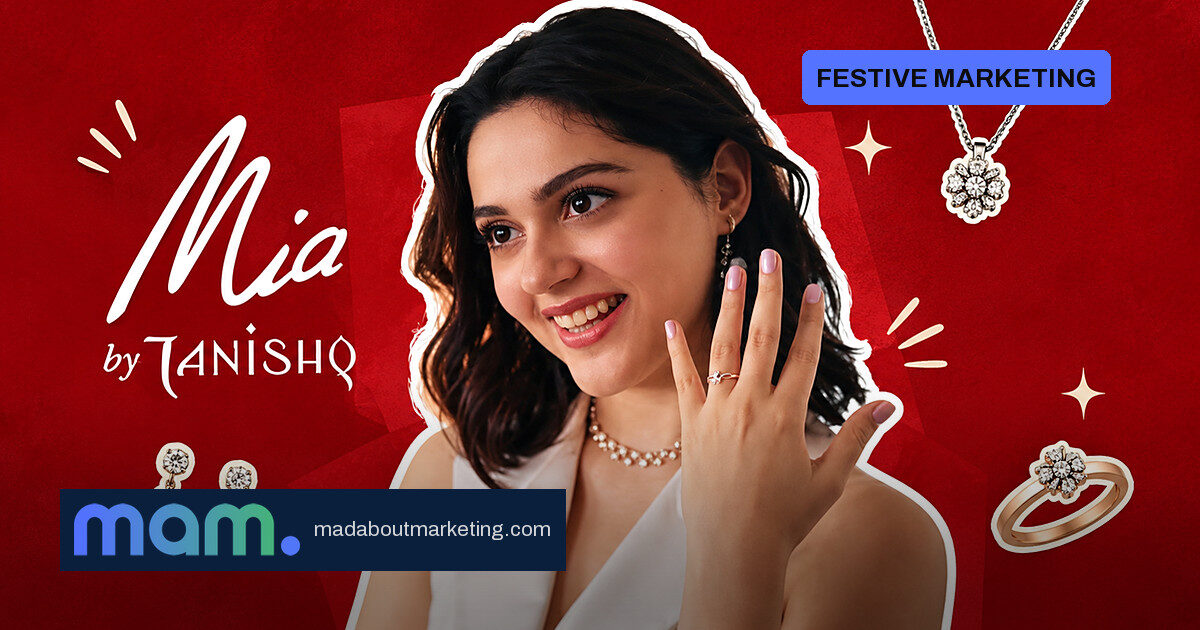
The festive campaign shows the brand’s ambassador buying herself a ring. When a friend assumes she is engaged, she explains it is a gift from her to herself. For Ramanan, this extends the “Precious Everyday” proposition: “It has got nothing to do with anything. It’s about her being authentic to herself.”
The target has shifted with the brand. Mia started about 15 years ago speaking to early jobbers; those buyers moved into the millennial bracket, and Gen Z now occupies much of that space. The product supports the positioning: an average Mia piece weighs around five to six grams, and earrings and finger rings are the biggest sellers, with festive demand adding complete sets, bangles, necklaces and longer earrings.
03 · Stores as 3 AM friends, not showrooms
Mia’s marketing is digital-led, but physical retail is becoming experiential. The brand has hosted matcha rave parties, bhajan raves, early-morning health runs that end in matcha parties and chat parties. In-store sessions range from mehendi and makeup to nail and gel art.
“I keep saying we are a 3 AM brand,” Ramanan says, describing the ambition as the closeness of a best friend, not a transaction. Business may follow, she says, but the first job is to make people feel good about who Mia is.
04 · What the playbook teaches brand leaders
- Own one emotional claim—Mia’s jewellery is for flaunting, not for the locker—and let product, campaign and store echo it.
- Use channel depth deliberately: quick commerce stays narrow, marketplaces carry a wider range, and offline stores hold the full assortment.
- Turn stores into branded experience spaces, giving consumers a reason to visit beyond a purchase.
- Let adjacent demand guide category expansion, as Mia did by moving from silver rakhis for men to gender-neutral rings, chains and pendants.
The festive shopper is shifting. Mia sees a festive spike even though it does not play in the heavy-jewellery segment, partly because lightweight pieces fit regular wear and accessible price points make self-purchase easier. Distribution includes around 320 standalone stores across about 160 cities, nearly 400 Tanishq stores, marketplaces such as Myntra, Flipkart, Amazon and Nykaa, and quick-commerce platforms including BigBasket and Swiggy Instamart.
“It’s incredible that people want jewellery delivered in 10 minutes,” Ramanan says, noting that quick commerce serves forgotten-occasion purchases. She sees no saturated market yet, and men’s jewellery is an emerging second act, though women remain the core.
The marketing take: Mia is not competing on carats; it is competing on permission—to wear joy every day, not lock it away.
Source: Afaqs!