Bata sees US$1 million yearly savings with Zocket’s AI creatives
Bata India estimates annual agency and production savings above US$1 million using Zocket's Brand Brain system for AI marketplace creatives.
01 · From design queue to brand system
A catalogue with 200 products live on six marketplaces needs thousands of images, tiles and banners before a campaign launches. The old way still moves those assets through a design queue one asset at a time, and that is the bottleneck Zocket is attacking.
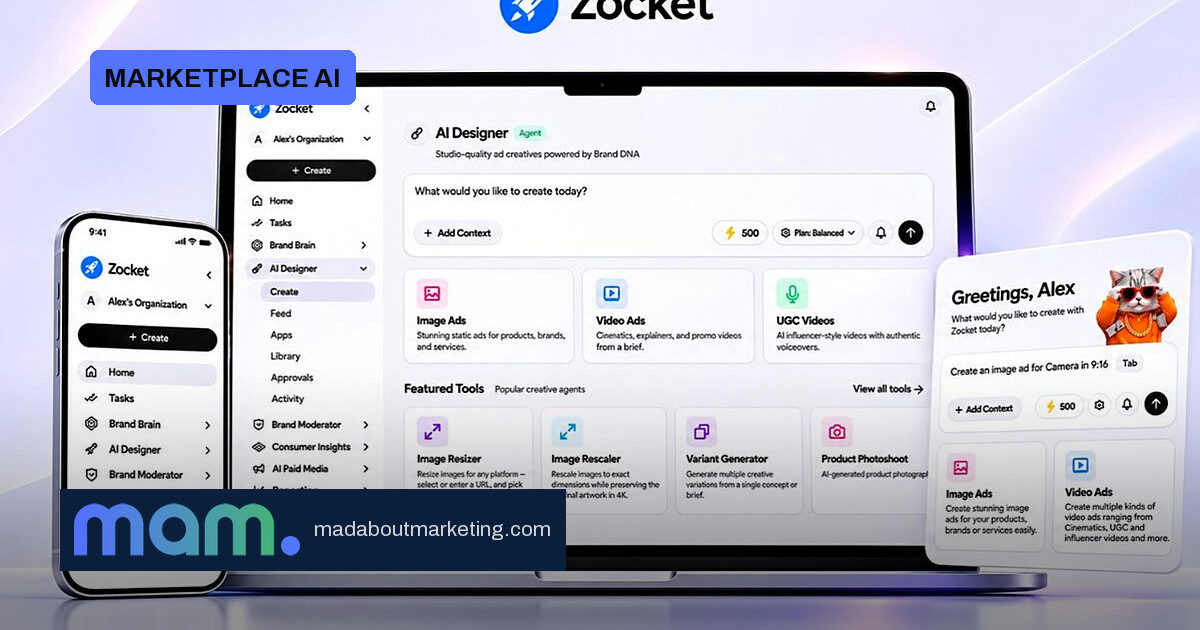
Zocket, an AI-native brand operating system for enterprise brands, has turned its attention to Amazon A+ content and Amazon Brand Stores. Its AI Designer works from a “Brand Brain” that holds product facts, approved claims, visual rules, personas and compliance constraints, so every brief starts with the same questions: which product is this, who is it for, and which claims are allowed?
“On a marketplace, the product page is the packaging. It is the only thing a shopper gets to pick up and turn over,” said Sundar, Co-founder and CMO, Zocket. “Most brands still produce it the way they produced print ads, one asset at a time, and the catalogue has outgrown that.”
The workflow has two marketplace apps: the A+ Marketplace app produces product page creatives, and the Amazon Brand Store app builds the wider storefront. Approvals route assets to reviewers, finished work lands in a library, and an activity trail records changes and sign-offs. Product teams check facts, designers check clarity, and brand reviewers check the message.
02 · Why one-shoe layouts should not fit every shoe
Zocket’s footwear sample work showed a simple version of the problem: a layout that suits one shoe can feel crowded when a product name runs longer, and a different angle changes how large the shoe appears on the page. The sample set rules for hero-image themes and shoe-to-frame proportions across formats, so each product keeps its own character while the collection reads as one.
The footwear work was for a prospective engagement, and adoption and results were not reported. But the same Brand Brain approach underpins Bata India’s creative production. In August 2026, Bata estimated annual agency and production savings of more than US$1 million across its wider creative production.
03 · Three rules for any marketplace shelf
Zocket’s guidance cuts across Amazon, Flipkart, Meesho and quick commerce:
- Write the story before designing the frames. A backpack listing needs one image for appearance, another for compartments, one for material and one for scale; each answers a different shopper question.
- Judge creative at the size shoppers see. On Blinkit, Zepto or Swiggy Instamart, products live as small tiles. If variants look identical at that size, the creative has failed.
- Treat launch as the start. Packaging, variants and approved wording change; customer questions reveal gaps. Repeated size confusion calls for a dimensions visual, and doubts about quantity call for a fresh look at the bundle image.
For marketplaces beyond Amazon, Zocket does not force a separate creative process. Brands adapt the approved master with Image Resizer for aspect ratios and Platform Adapter for platform-specific treatment. The product facts stay fixed while composition changes.
The marketing take: on a marketplace, the product page is the packaging, so build it from approved brand rules and let the catalogue scale without the brand drifting.