After 70 years, HRI rebrands to ‘Where Beauty Evolves’
Hygienic Research Institute refreshes its corporate brand after 70 years with chlorophyll, signalling a multi-brand, multi-category beauty portfolio.
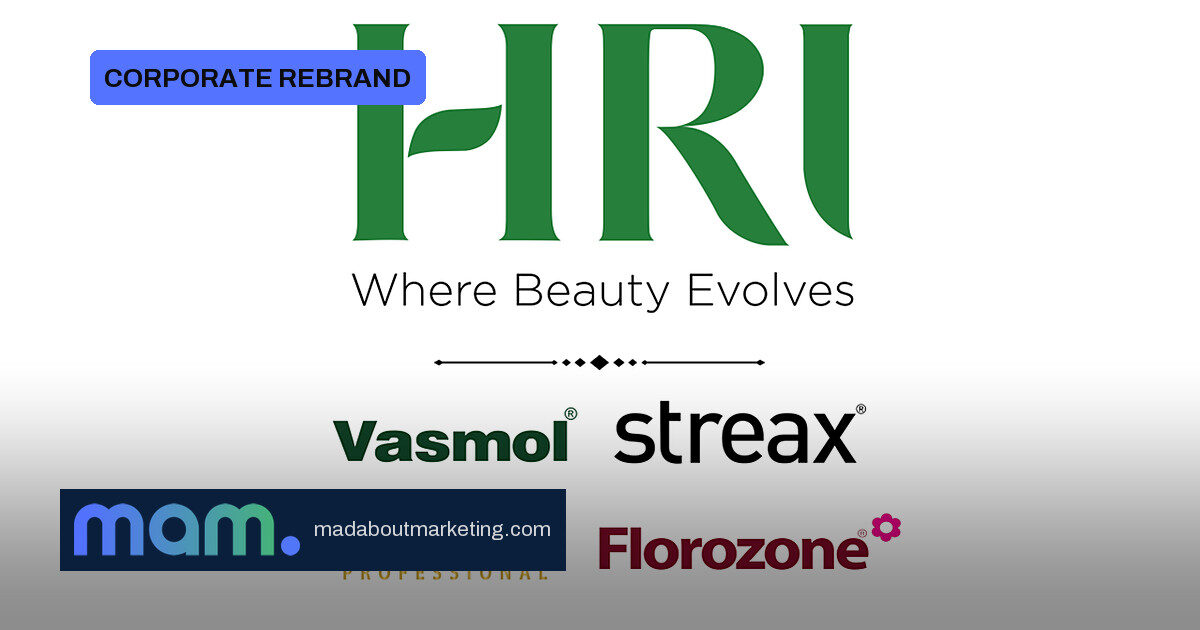
Hygienic Research Institute has spent 70 years building brands that sit on Indian shelves and in salons. Now the parent is stepping forward with a refreshed corporate identity and a new tagline: Where Beauty Evolves.
The company, founded in 1957, owns Vasmol, Florozone, Streax and Streax Professional, with a portfolio that spans hair colour, hair care, skincare and professional salon solutions. The rebrand, developed with brand consultancy chlorophyll, is a corporate-layer change rather than a packaging overhaul for those consumer-facing brands.
The move matters to India’s beauty marketers because this is not a product launch. It is a corporate repositioning aimed at making a 70-year-old company easier to understand as it competes for retail relationships, talent and share in a category where the parents behind familiar brands often stay invisible.
01 · The parent brand catches up with the portfolio
HRI’s challenge is the classic house-of-brands tension: the product names hold the equity, but the parent’s story had not kept pace. Managing director and CEO Dheeraj Arora put it plainly: “From a single-brand, single-category business, we have evolved into a multi-brand, multi-category organisation.”
The new identity has to make HRI legible to partners, talent and the trade without competing with Streax or Vasmol for consumer attention.
02 · What ‘Where Beauty Evolves’ is really saying
The tagline positions HRI as an innovation engine rather than a holding name. Arora says it reflects the ambition to strengthen the company’s presence in beauty and personal care, anticipate evolving consumer needs, and create solutions that empower individual expression through beauty.
For CMOs, the lesson is sequencing. A corporate rebrand works when the portfolio has already diversified; the parent story then helps people see the logic across categories without forcing one brand’s identity onto another.
Three questions a portfolio rebrand should answer
- Has the product portfolio outgrown the company’s old story?
- Does the new identity serve partners and talent, not just consumers?
- Can the tagline carry product claims, or is it mostly poetry?
03 · The thinking behind the identity
chlorophyll co-founder and managing director Kiran Khalap says the work began with understanding HRI’s heritage, consumers, capabilities and future ambition. Research, brand immersion and an outside-in perspective helped identify a territory that could carry the business into its next chapter while honouring seven decades of equity.
That outside-in lens matters. Most corporate rebrands stall because they start with what the company wants to say. HRI and chlorophyll appear to have started with what the portfolio already is: a multi-category beauty company with both consumer and professional lines.
04 · What to watch next
This is not yet a consumer rebrand. The test will be whether HRI shows up consistently on corporate communications, trade platforms, hiring and digital. If the corporate brand begins endorsing individual product brands, the tagline moves from strategy statement to public promise.
For brand leaders, the immediate KPI is internal alignment and trade clarity, not social chatter. A parent logo used carelessly on a young, independent-feeling product brand can dull its edge.
Marketing take: a parent brand can stay silent only until its portfolio outgrows a single category; then it needs a story that unites without stealing the spotlight from the brands shoppers already trust.
Source: Afaqs!