H.I.M debut rides an 850% surge in men’s skincare searches
Ranveer Singh and Aman Gupta launch H.I.M, an eight-product men's personal care range for Indian skin, as men's grooming searches surge 850%.
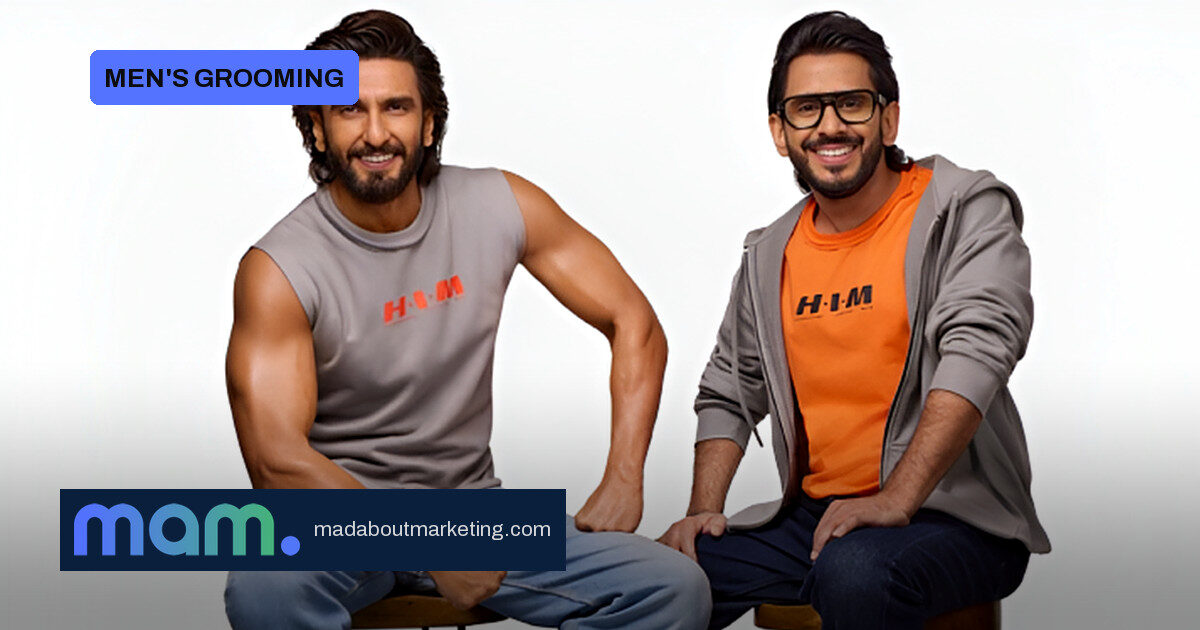
India’s men’s grooming aisle just gained its most high-profile entrant. Actor Ranveer Singh and entrepreneur Aman Gupta launched H.I.M — short for Handsome Indian Man — on November 17 in Mumbai. The personal care brand is built on research into Indian male skin and designed for local heat, humidity, pollution and hard water. It opens with eight products across face, body and hair, supported by a film featuring both co-founders.
01 · Why H.I.M exists
The founders’ premise is blunt: men’s grooming products in India have mostly been adapted from formulations created for other consumer segments. H.I.M’s counter is a research-led range tailored to Indian male skin and its environmental conditions. Its proprietary IN·XT molecule is designed to help skincare actives penetrate the skin’s surface through a protective delivery layer. The technology was tested on Indian men under heat, humidity and pollution, drawing on insights from an all-male research panel.
02 · The category maths
The launch lands in a market that is already moving fast:
- ₹2.2 lakh crore: India’s beauty and personal care market today
- About ₹4 lakh crore: the projection for FY2031, nearly double today’s size
- 850%: the five-year rise in searches for men’s skincare routines
- Over 12%: annual category growth cited by co-founder Aman Gupta
‘Almost every Indian man has borrowed a face wash from his sister, wife or girlfriend at some point. Me included,’ Gupta said.
Singh frames the brand around identity: he was once told he was too handsome for an Indian, and he insists that being Indian should never make being handsome a surprise. ‘Handsome and Indian were never two different things,’ he said.
03 · What brand leaders should watch
H.I.M is as much a positioning case as a product launch. Its differentiator is not just celebrity — it is a claim of being built for the buyer’s actual conditions. Gupta describes Singh as an obsessive co-founder who tested every formulation from the first samples to the final products. That founder-as-tester narrative gives the brand permission to make strong efficacy claims and signals product seriousness, not just star power.
For CMOs, the lesson is localisation as a moat. In a category growing this fast, search-driven demand rewards brands that show up with products and content built for a specific use case — Indian male skin, weather and water — rather than a repackaged line with a masculine label.
The takeaway: The fastest-growing shelf space in personal care belongs to brands that stop rebadging lines made for someone else and start designing for the buyer’s own skin, climate and water.