Hinge’s Everyday Gestures in Love makes the mundane romantic
Hinge's new campaign from Talented and Dar Gai trades grand romance for ticket bookings and balcony nets, making small acts feel like proof.
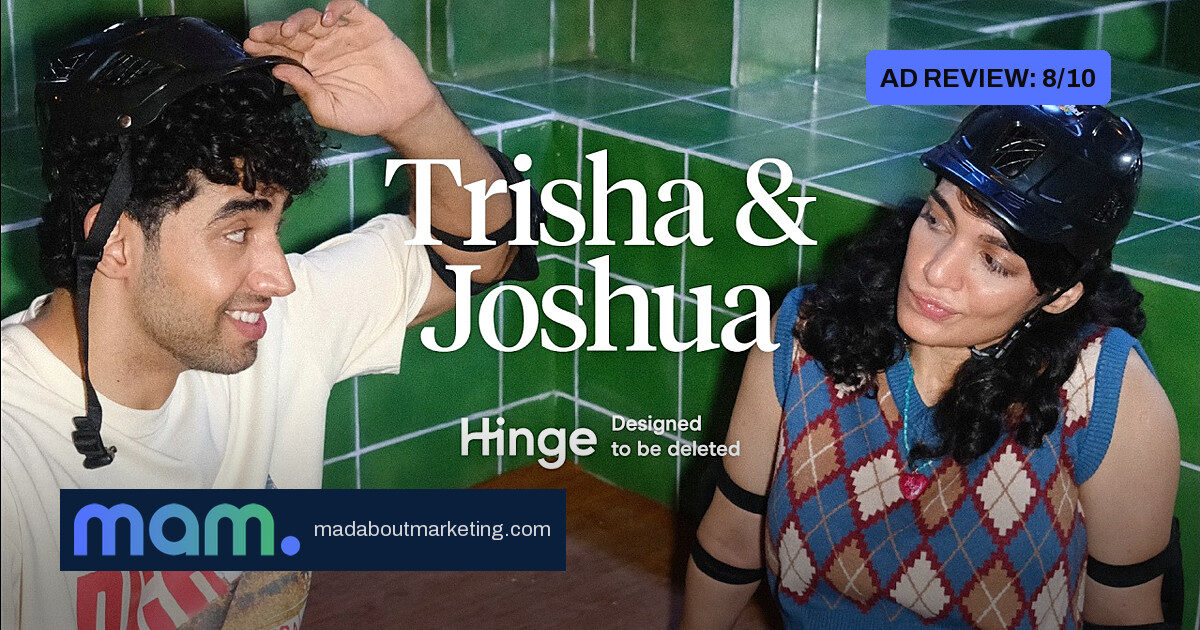
Our score: 8/10 · Hinge, “Everyday Gestures in Love”
Verdict: Specific, ordinary moments give Hinge a confident point of view, but the idea spreads across too many stories to leave one signature image.
What works
- The insight lands because the gestures are specific, from booking sibling tickets to a bird-proof net.
- The layered visual formats make the films feel like memory, not polished advertising.
- Talented's line about love as a skill gives the platform a defensible point of view.
What misses
- Four films and six stories spread the idea thin; no single gesture becomes the campaign's signature.
- It speaks to couples already formed more than it gives new users a reason to act.
The lesson: Sell the outcome through small, specific proofs; ordinary details are harder to fake and build more trust.
01 · The ad
Dating platform Hinge has launched ‘Everyday Gestures in Love’, a new campaign built on the small, everyday acts of consideration that can indicate a meaningful relationship. Created by Talented, directed by Dar Gai and produced by Jugaad, the work comprises four films and six shorter stories. It sits within Hinge’s ‘Designed to be Deleted’ platform, which frames the app as a route to a relationship that eventually moves beyond the app.
The campaign draws from real-life experiences and recreates the moments people remember as turning points. It deliberately shifts focus away from grand romantic gestures. The stories rest on details such as remembering a partner’s brother while booking movie tickets, fixing a balcony net for someone afraid of birds, understanding when to make someone laugh, and making long distances feel manageable.
The visual treatment is intimate by design. It layers digital cameras, photographs, Super 8, phone cameras and video calls, sometimes placing one image within another, to mimic how people actually revisit their memories.
02 · What works
The central insight is precise: people rarely point to bouquets or Valentine’s Day gifts when they recall the moment they knew. They point to small, specific acts of attention. That is a strong strategic fit for a dating app that wants to be deleted, because it treats the relationship after the app as the real success.
The craft reinforces the idea. The mixed formats make the films feel like memory rather than advertising gloss. Aarushi Periwal, Founding Member and Creative at Talented, frames the thinking around Alain de Botton’s idea of love as a skill rather than an enthusiasm. That gives the campaign a point of view: the effort hidden inside a love that feels effortless is what makes it romantic.
03 · What misses
Four films and six shorter stories spread the idea across many proof points. That makes the platform thought clear, but it also means no single gesture becomes the campaign’s signature image. For a brand platform, one tightly owned moment can travel further than a collection.
The stories also look back from relationships already formed. They are less explicit about what a new user should do next: open the app, start a conversation, or bring more attention to an early date. The warmth is persuasive, but the call to action is soft.
04 · The verdict
Score: 8/10. Hinge’s campaign earns its warmth because the details are specific and the direction treats memory as the format. It is a confident extension of ‘Designed to be Deleted’. The main weakness is that the idea is distributed across so many films that no single visual becomes unmistakably Hinge’s.
05 · The lesson
For a brand built on an outcome, dramatise the small proof points, not the category clichés. Ordinary gestures are harder to fake and more convincing as evidence.
Watch the original: Hinge on YouTube. Shown for review; the rights stay with the brand.
Source: Storyboard18