Why Racold is putting titanium in water heaters
Racold's new Titanium Ultracore technology strengthens water heater tanks against hard water and thermal stress. Here's the marketing logic behind the film.
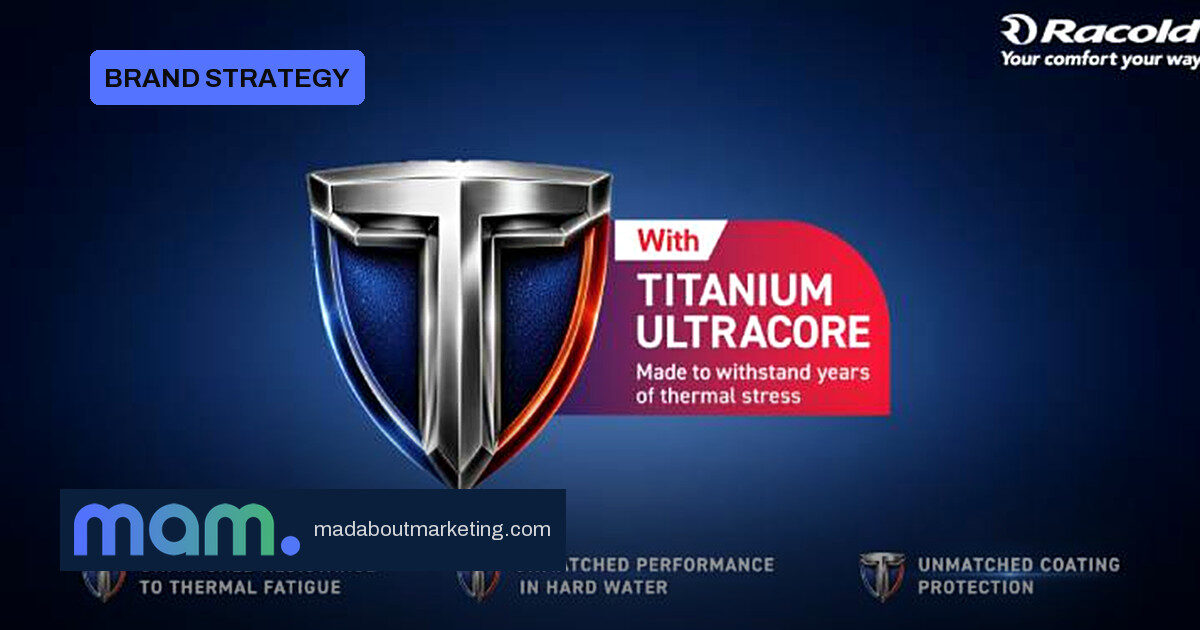
Racold is moving the water-heater durability story from the heating element to the tank itself. The Ariston Group brand has unveiled Titanium Ultracore, a titanium-enriched inner-tank protection technology developed through years of research, and a digital film that explains why the tank deserves more attention.
01 · The durability problem it targets
Water heaters go through repeated heating and cooling cycles during their working life. That creates thermal stress inside the tank, and hard water—common in many parts of India—adds further pressure on the tank’s inner coating. Racold’s answer is to integrate titanium into the protective layer, which the brand says improves resistance to thermal fatigue and delivers stronger protection under demanding water conditions.
- Thermal stress: repeated heating and cooling can weaken conventional inner-tank coatings.
- Hard water: regional water quality accelerates coating wear over time.
- Titanium Ultracore: a titanium-enriched coating designed for greater tank resilience.
02 · Reason-why, not just a spec
Mohit Narula, Managing Director, Ariston Group India, frames the launch around consumer pain points.
Durability has become an increasingly important consideration for consumers.
That line is the strategic centre of the film. Instead of simply asserting that Racold tanks are tough, the new digital film shows the mechanism: repeated heating and cooling, the stress on the inner coating, and the titanium-enhanced layer as the protective response.
03 · What CMOs can take from it
This is classic reason-why advertising, applied to a category where invisible material benefits often stay buried in product spec sheets. Racold gives the coating a distinct, ownable name—Titanium Ultracore—and uses visual explanation to make the material science understandable. The sequence is the lesson: demonstrate the failure mode before introducing the fix, so the benefit feels earned rather than asserted.
The approach also fits a broader pattern in consumer durables: converting an upstream material choice into a branded ingredient. When the consumer cannot see the part, the marketing job is to visualise the stress it absorbs. Racold’s film does that with engineering-style explanations rather than lifestyle gloss, signalling that the brand wants to be judged on reliability, not just heating speed or aesthetics.
For durable goods marketers, local context matters too. Tying the story to hard water—a condition many Indian households recognise instantly—makes a technical feature feel relevant and urgent.
Marketing take
When a product’s most important feature is invisible, name it, show the failure it prevents, and anchor it to a condition the buyer already recognises.
Source: MediaNews4U