

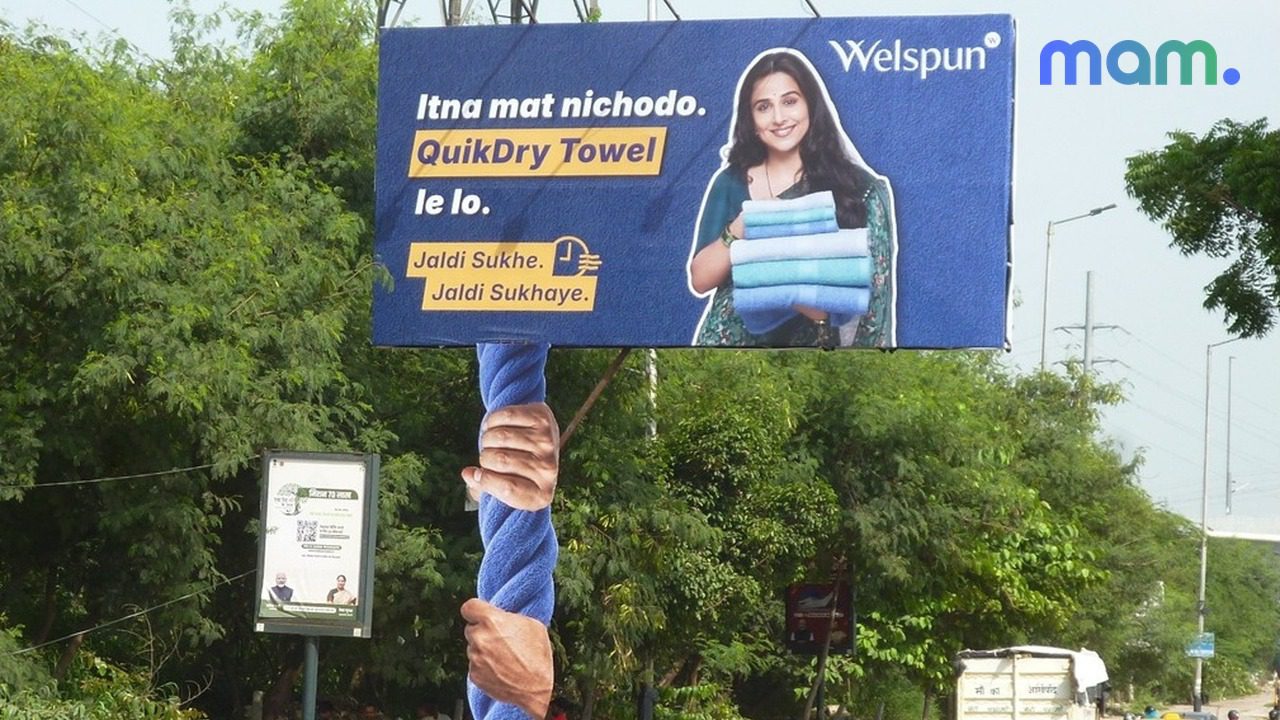
~ Welspun Living scales QuikDry terry texture onto buses and hoardings across Delhi, Mumbai and Bengaluru — monsoon messaging rewritten city by city ~
Mumbai, September 2026: Welspun Living has put QuikDry Towels on the street — literally. Its latest monsoon campaign scales the towel’s own terry texture and colours across large-format outdoor sites, buses, cabs, autos, local trains and metro trains in Delhi, Mumbai and Bengaluru, turning transit media into oversized product surfaces rather than generic weather ads.
That product-as-media move sits against a bigger convenience shift: India’s clothes dryer market is projected to grow from USD 14.6 billion in 2025 to USD 21.3 billion by 2034 (IMARC Group). QuikDry’s pitch is speed without another appliance — faster-drying towels for shrinking urban homes that still fight the clothesline through monsoon humidity.
The platform sits under Welspun’s brand philosophy ‘Kyunki Farq Padta Hai’ — small everyday choices that add up. This monsoon, across three cities, the towel isn’t just being advertised. It’s becoming the advertising.
Marketing take: Functional benefits die on abstract claims. Welspun made QuikDry’s drying edge something you can see on the commute — texture as media, city weather as brief — so the product argument rides the same rain the consumer is stuck in.
Ruchika Arora, CEO, Welspun Living Domestic Business, said: “Every household has felt the frustration of a towel that stays damp through the monsoon. We didn’t want to simply talk about QuikDry solving that problem, we wanted to make the benefit visible in the real world. That’s why we took the towel’s actual texture and colours onto buses and hoardings across Delhi, Mumbai and Bengaluru, with the communication adapted to how the monsoon behaves in each city. When a product is designed to solve an everyday problem, we believe the advertising should feel just as relevant to everyday life.”
The creative refuses a single national monsoon line. Mumbai’s long, humid stretch (relative humidity often 74–81% in peak months, with more than 20 rainy days in July and August, per IMD) gets treated differently from Delhi’s intermittent heavy spells and Bengaluru’s steadier damp run. Communication shifts with how rain actually shows up in each city, while the towel texture stays the visual constant.


